
Free setup tool
BUMP STOP AND SPRING LOAD
A bump stop is a second spring that only works at the bottom of the travel. Put in the spring, the air gap and the bump's rate sheet, and it draws the load the corner makes at every inch.
SPRING
BUMP STOP
Force at each depth into the bump, off its rate sheet
The starting numbers are read by eye off a published bump stop chart and are only there to show the shape. Put in the numbers for the bump you run.
PUSH THE CORNER DOWN
Drag it down until the bump touches, then keep going and watch how fast the number climbs. From a travel indicator or a shock sensor you know how far the car really gets.
- Down number
- 2,513lb
- Spring plus bump at that travel.
- From the spring
- 2,113lb
- From the bump
- 400lb
- 1.25 in into the bump.
- Rate right there
- 2,120lb/in
- What one more inch would cost at this point.
LOAD AGAINST SHOCK TRAVEL
Up to the air gap the corner is on the spring alone and the line is straight. Past it the bump stop adds its own force on top, gently at first and then very fast. The blue line stops where the rate sheet does.
WHAT A BUMP STOP IS
Jay Neal puts it plainly in his bump stop rates post: it is just a spring. It is a short, very progressive one. It does nothing until the shock has used up the air gap, then it adds its own force on top of the coil spring.
He gives two reasons to run one. The first is to stop the car at the bottom of its travel, on entry or in a hole. The second is to build load quickly once the car is down. The plot shows both: the line is the plain spring until the bump touches, then it turns upward.
THE DOWN NUMBER
In his smash numbers post, Neal defines the down number as the load of the spring and the bump stop together at a given amount of compression. It is what a spring smasher reads with both on the shock.
down number = spring load at ride height + rate × travel + bump force at (travel − air gap)
He is careful to say it is not the load the tire sees, and that is right. The spring and bump are usually inboard of the tire, so the tire sees less than they make, and the tire also carries the weight of the wheel, hub and brake that the spring never holds up.
WHY THE AIR GAP MATTERS SO MUCH
Look at the right-hand end of the plot. The bump stop is so steep there that an eighth of an inch changes the load by a hundred pounds or more. That is why the air gap is set with shims and why two cars with the same parts can be very different. The rate box in the calculator shows how many pounds the next inch would cost at the travel you entered. Compare it to the spring rate alone.
It is also why Neal says you need a travel indicator. The whole answer depends on how far the shock really moves, and a photo of the car on the track does not tell you that to an eighth of an inch.
WHAT IT LEAVES OUT
The calculator joins the points on the rate sheet with straight lines, so it is a little low between them. Bump stops also read differently squeezed fast than slow, and they change with heat and age. Treat the number as a way to compare two setups, and check it on a smasher.
More free tools on the setup tools page. It runs in your browser. No account, and nothing you enter leaves your machine.
From the shop
SPINDLE MOUNT CASTER TOOL
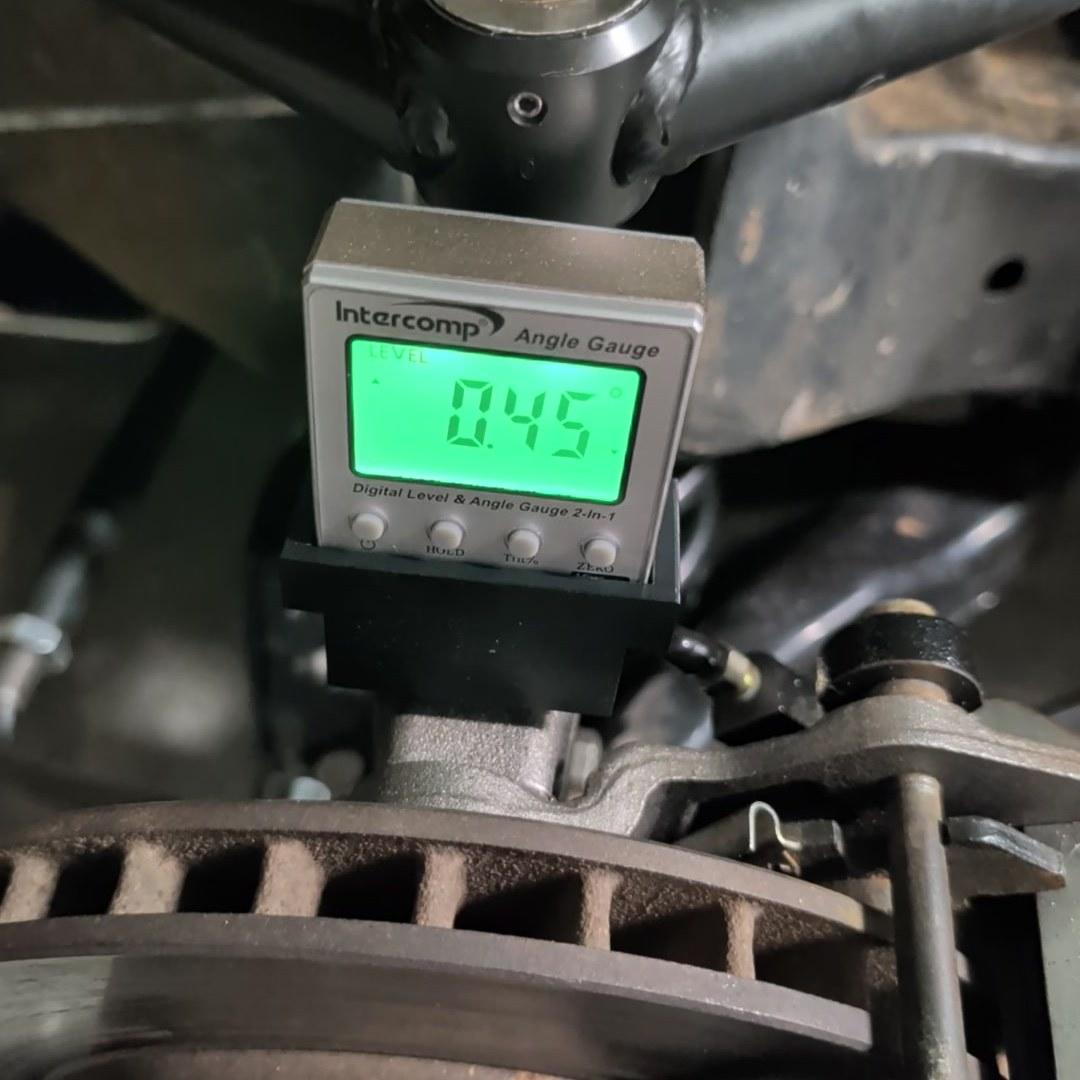
Read caster directly on the car. Fits over the knuckle on a Speedway 3-piece spindle, works with a digital level. No bubble sweep.
$39.99See the tool
Think something on this page is wrong? Use the button in the corner and tell me. That is how these get better.