
Free setup tool
FRONT END GEOMETRY
Six calculators for what the front end does as it moves: camber, roll center and bump steer from the pickup points, Ackermann, anti-dive, steering jacking, and caster in the corner.
CAMBER, ROLL CENTER AND BUMP STEER
Seen from the front, a corner is two arms and an upright. Move the wheel and the upright tips, which is camber gain. The tie rod swings on its own arc, and wherever that arc disagrees with the path of the steering arm, the wheel is steered. That is bump steer.
Two things set it. The height of the tie rod ends decides where the curve crosses zero. The length of the tie rod against the arms decides how much it curves. A tie rod the same length as the lower arm and parallel to it is close, and exact only if the upright does not tip as it travels.
ONE FRONT CORNER, SEEN FROM THE FRONT
- Camber change here
- -1.14deg
- Bump steer here
- 0.008in
- Toe out.
Drag the wheel up and down and watch the tire tip and the roll center move. Then change one thing and drag it again.
To use your own car, measure each point at ride height: how far out from the center of the car, and how high off the ground. The numbers it opens with are an example, not a real chassis.
Lower arm, inner pivot
Lower ball joint
Upper arm, inner pivot
Upper ball joint
Tie rod, inner end
Tie rod, outer end
- Roll center height
- 2.89in
- At ride height, if both sides are built the same.
- Camber change, 1 in up
- -0.76deg
- Negative is the top leaning in.
- Bump steer, 1 in up
- 0.004in
- Toe out.
- Bump steer, 2 in up
- 0.013in
- Toe out.
Camber against travel
Bump steer against travel
Roll center height against travel
WHERE THE FRONT ROLLS ABOUT
The roll center above comes from arm angles. There is a second answer to the same question that comes from the springs. If one front spring is softer than the other, the soft side moves more, and the chassis rocks about a point nearer the stiff side.
WHERE THE FRONT END ROLLS ABOUT
- Rolls about a point
- 18.2in
- Left of center.
- Right front, at the wheel
- 36lb/in
- It is on both springs.
This is sometimes called the elastic roll center. It is set by spring rates, not by arm angles. A soft right front puts it toward the left front, so the right front does most of the moving. Each time the right side gets stiffer, when the soft spring locks out and again when the bump stop touches, the point jumps toward the right and the left front has to start moving instead. The geometric roll center from the arms is a different thing, and a real car has both.
ACKERMANN
In a turn the inside tire runs a tighter circle than the outside one, so it needs to steer more. Ackermann is how much more, and it shows up as toe-out that grows with steering. It comes from where the outer tie rod end sits relative to the ball joints.
ACKERMANN, READ AS TOE
- Toe gained here
- 0.117in
- Toe out.
- Wheels apart by
- 0.25deg
- Toe gained at 20° left
- 0.348in
- Toe out: the inside tire turns more.
- Toe gained at 10° right
- 0.162in
- Toe out.
Make the two arms different and the curve stops being the same left and right. That is how a car can gain toe turning into the corner and gain almost none when the driver countersteers.
ANTI-DIVE
Tilt the upper arm mount and braking force gets a path into the chassis that holds the nose up, or pulls it down. It is a force that scales with how hard the brakes are on. It is not extra spring rate: off the brakes it is gone.
ANTI-DIVE
- Anti-dive
- 14%
- Share of the brake dive the arms hold up.
- Lift per 100 lb of braking at this tire
- 3.5lb
- Where the arm lines meet
- 157 in back
- 5.5 in off the ground.
SCRUB RADIUS AND STEERING JACKING
Caster and kingpin angle tilt the line the wheel steers around. Because of that tilt, steering raises one front corner and lowers the other, which moves weight across the diagonals the same way a jack bolt does. Wheel offset changes the scrub radius and so changes how much.
SCRUB RADIUS, AND HOW STEERING JACKS THE CORNER
- Scrub radius
- 3.23in
- Tire center to where the kingpin line meets the ground.
- Corner moves, 15° left
- -0.079in
- Let down. This tire and its diagonal lose load.
- Corner moves, 15° right
- 0.105in
- Pushed up.
The tire does not pivot on its own center. It swings around the point where the kingpin line meets the ground, on a tilted circle. One way the tire is driven down and lifts its corner, the other way it comes up and lets the corner settle. More caster or more scrub radius makes the slope steeper. Slide the spacer and watch it.
CASTER IN THE CORNER
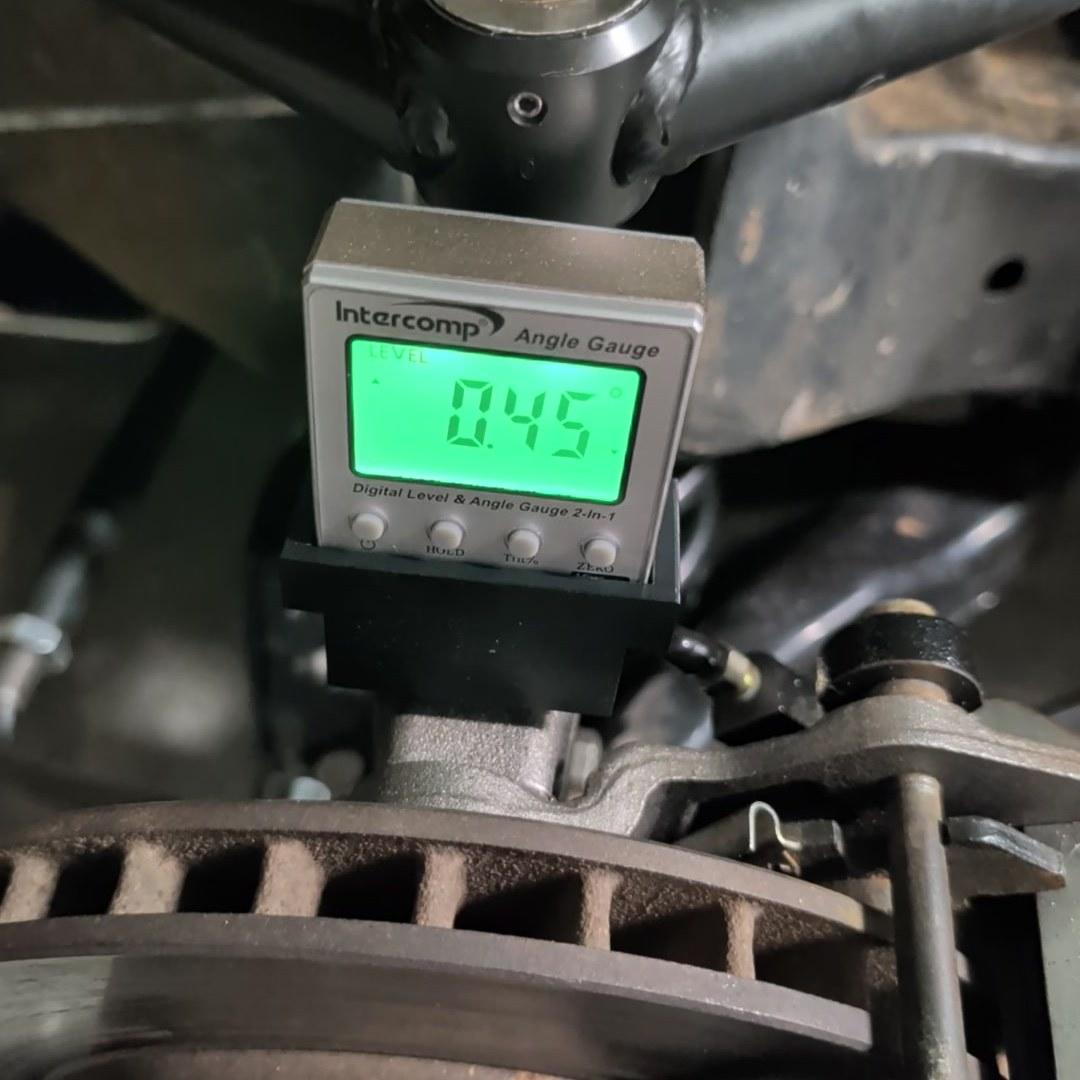
Caster set on the plates is where the car starts. With the nose down and the rear up, the reading is lower. To see the starting number on the car, the spindle mount caster tool reads it straight off the spindle with a digital level.
CASTER WITH THE CAR IN ITS ATTITUDE
- Chassis pitched nose down
- 1.59deg
- Caster in that attitude
- 3.41deg
- From pitch alone.
- Caster lost
- 1.59deg
Caster is measured against the ground. Tip the whole chassis nose down and both ball joints tip with it, so the reading drops by the same angle the car pitched. This is the part that comes from pitch alone. Arm geometry adds to it or takes from it: mounts set with anti-dive move the upper ball joint as the wheel travels. Measure it on the car in its attitude to get the whole number.
More free tools on the setup tools page. Everything runs in your browser. No account, and nothing you enter leaves your machine.
From the shop
SPINDLE MOUNT CASTER TOOL
Read caster directly on the car. Fits over the knuckle on a Speedway 3-piece spindle, works with a digital level. No bubble sweep.
$39.99See the tool
Think something on this page is wrong? Use the button in the corner and tell me. That is how these get better.