
Free setup tool
REAR AXLE GEOMETRY
Six calculators for a solid rear axle: where it points, how it moves sideways and fore and aft, and what the driveline and top link see.
REAR STEER
Lengthen one trailing arm and that side of the rear end moves back. The rear end now points off to one side, and the car follows it.
REAR STEER FROM A BAR OR ROD CHANGE
The rear end's angle is drawn eight times life size.
A sixteenth at the bar is not a sixteenth at the tire. Drag it and watch the front of the line move.
- Difference at the tires
- 0.625in
- One rear tire ahead of the other by this much.
- Rear end pointed off straight
- 0.51deg
- Off line at the front axle
- 0.96in
- Where the rear end is aimed, a wheelbase ahead.
The rear end pivots like a gate. A small move at the bars is a bigger move out at the tires, because the tires are further apart than the bars, and bigger again by the time you follow the line up to the front of the car.
J-BAR
The J-bar, or panhard bar, holds the rear end side to side. Its two mount heights set its angle, and its angle sets two things: how much the chassis and rear end slide past each other as the car moves, and how much of the cornering side load is turned into lift.
J-BAR: ANGLE, SIDE SHIFT AND JACKING
- Side shift here
- 1.10in
- Bar angle here
- 24.9deg
- Split
- 5.00in
- Frame end minus pinion end.
- Bar angle
- 15.3deg
- Lift per 100 lb of side load
- 27lb
- Pushing the frame end up and the axle end down.
- Side shift, chassis up 3 in
- 1.10in
- How far the rear end and chassis slide past each other.
The bar is a fixed length, so its ends can only move on an arc. As the chassis rises and the split grows, the bar reaches less far across the car and pulls the two ends toward each other. A bar that starts steeper moves more per inch, and a longer bar at the same split moves less. The lift number is plain trigonometry: side load through a sloped bar has an up-and-down part equal to the load times the slope.
LEAF SPRING REAR STEER
A leaf spring locates the axle as well as holding the car up, so travel moves the axle forward and back.
LEAF SPRING REAR STEER
Start level and the axle barely moves. Start off level and it runs forward one way and back the other.
- Axle moves, 2 in of travel
- -0.080in
- Right side, compressing. Minus is forward.
- Axle moves, 4 in of travel
- -0.322in
- Steer, right up 2 and left down 2
- 0.00deg
- Angle of the rear end from the difference between the sides.
The front half of a leaf works like a trailing arm pinned at the front eye. The axle is furthest back when it is level with the eye, and it moves forward whichever way it travels from there. Start level and the first inches move it very little. Start above or below level and one direction moves it forward, the other back, which steers the rear end as the car rolls.
PINION ANGLE
Pinion angle here means the pinion against the transmission, not against the driveshaft.
PINION ANGLE AND THE U-JOINTS
- Front joint angle
- 2.0deg
- Rear joint angle
- 1.0deg
- Pinion off parallel
- 3.0deg
- How far it has to wind up under power to line up with the transmission.
- Left at the pinion
- 0.09%
- The joints are at different angles, so some is left.
A U-joint working at an angle does not turn its output at a steady speed. It speeds up and slows down twice every turn. A second joint at the same angle, with the yokes lined up, takes it back out. That is why the target is the pinion parallel to the transmission when the car is under power, and why the static setting is a few degrees nose down: the rear end winds up toward parallel when the throttle goes on.
PULL BAR LOAD
On a three-link, the top link holds the housing from rotating under power.
PULL BAR AND TOP LINK LOAD
- Pull on the bar
- 1,096lb
- Bar stretches
- 0.61in
- Before any preload.
- Push on the lower links
- 2,596lb
- Both together.
The tires push forward at the ground, a tire radius below the axle. That tries to roll the housing nose up. The pull bar holds it back, and how hard it has to pull depends on its leverage: mount it higher and the load drops. This is the load with the links level. Angled links change it, and the 4-link calculator handles that.
BENT HOUSING
After a hit, a housing can be checked with a tape before it goes on a jig.
BENT AXLE TUBE
- Bend, if all on one end
- 0.15deg
- Shows up as toe
- 0.15deg
- With the bend pointing front or back.
- Shows up as camber
- 0.00deg
- With the bend pointing up or down.
A bent tube is one angle that reads as toe or camber depending on which way it points. Turn the housing a quarter turn and toe becomes camber. That is why the check is done at four positions: a straight housing measures the same at all of them. Measured out at the tire tread the same bend shows about twice as large, because the tread is about twice as far from the center as the rotor edge.
For a four-bar or triangulated four-link, the 4-link calculator solves the whole linkage: anti-squat, roll center, rear steer, push point, wheelbase change and housing rotation as the car moves.
More free tools on the setup tools page. Everything runs in your browser. No account, and nothing you enter leaves your machine.
From the shop
SPINDLE MOUNT CASTER TOOL
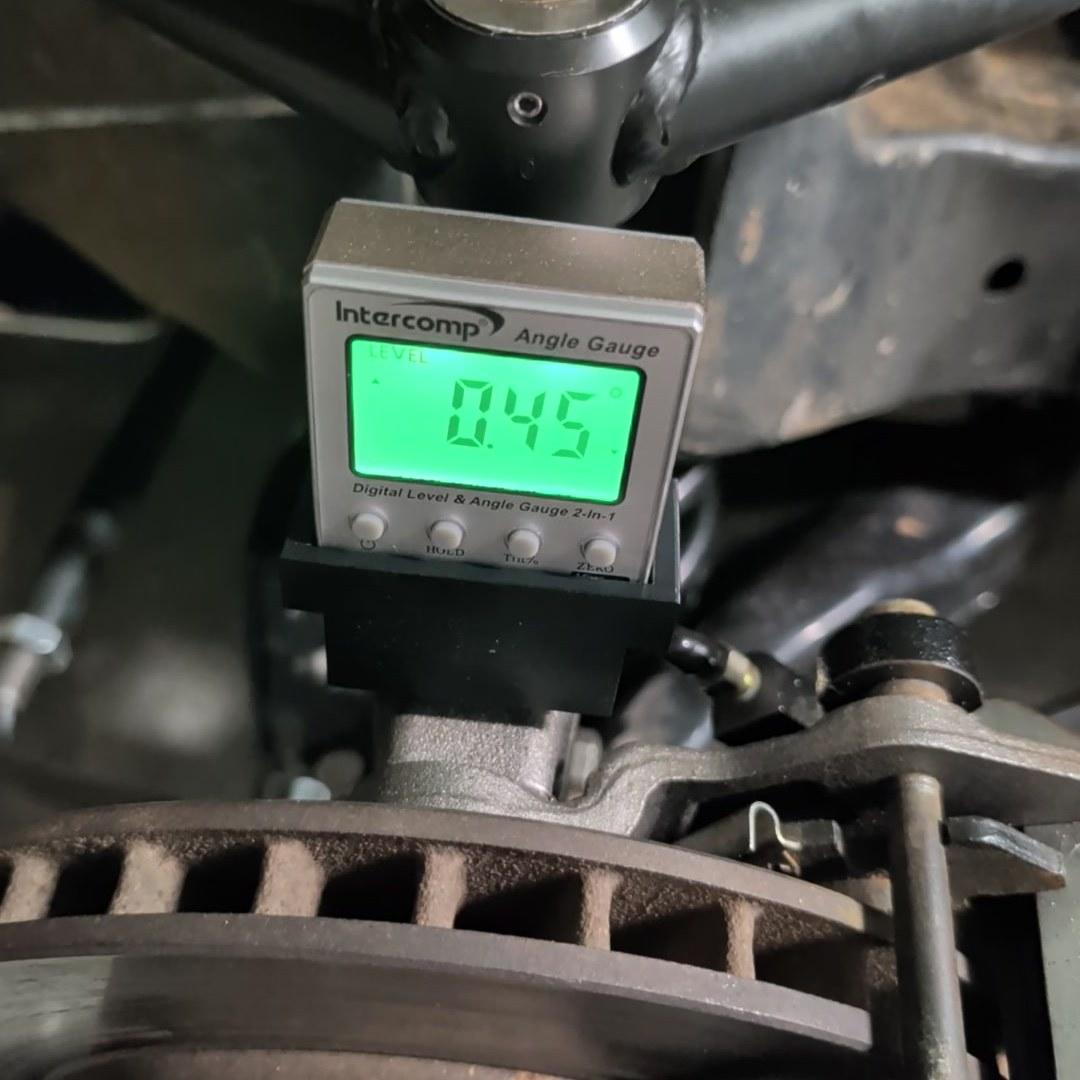
Read caster directly on the car. Fits over the knuckle on a Speedway 3-piece spindle, works with a digital level. No bubble sweep.
$39.99See the tool
Think something on this page is wrong? Use the button in the corner and tell me. That is how these get better.