
Free setup tool
SPRING MATH
Load numbers, smash numbers, stack charts and angle charts are all the same few pieces of math. Each one is here as a calculator you can move.
LOAD, RATE AND HEIGHT
A spring's rate is how many pounds it takes to squeeze it one inch. The load in a spring is its rate times how far it is squeezed from its free height. That one line is all a load number is. Turn it around and it gives the height to set a spring to for the load you want.
Springs are least consistent in the first inch from free height. A load set with only an inch or two of squeeze is worth checking on a spring rater.
LOAD, RATE AND HEIGHT
- Spring compressed by
- 1.667in
- Spring height at that load
- 11.333in
- About 11-5/16" on a tape.
- Each 1/16 in is worth
- 14.1lb
- How much a small measuring error moves the load.
LOAD NUMBERS DOWN THE TRAVEL
The load at ride height is not a choice. The spring is holding the car, so it carries whatever that corner weighs on it. From there the load climbs by the rate for every inch the spring is squeezed. Compare two springs and you can see what a spring change does to the number at the travel the car runs at.
LOAD NUMBERS DOWN THE TRAVEL, FOR TWO SPRINGS
The right front pushed down by the travel you chose. Its bar is the load spring A is making there.
- Spring A at 3.00 in
- 1,475lb
- Spring B at 3.00 in
- 1,625lb
- To match B with spring A
- 0.55in
- more travel needed on A, or a bump stop to make up the difference.
| Travel | Spring A | Spring B |
|---|---|---|
| Ride height | 650 | 650 |
| 1 in | 925 | 975 |
| 2 in | 1,200 | 1,300 |
| 3 in | 1,475 | 1,625 |
| 4 in | 1,750 | 1,950 |
Both springs start at the same load, because at ride height the spring is holding the car and the car weighs what it weighs. From there each spring gains its rate times how far it is squeezed. The stiffer one is ahead at every inch.
CHANGING SPRINGS WITHOUT LOSING RIDE HEIGHT
Swap a spring and the load it carries does not change. What changes is how tall it stands while carrying it. A stiffer spring squeezes less, so the adjuster has to come back by the difference.
TURNS TO KEEP RIDE HEIGHT AFTER A SPRING CHANGE
- Old spring height, loaded
- 10.500in
- New spring height, loaded
- 11.500in
- Move the adjuster
- 8.0turns
- The new spring stands 1.000 in taller under the same load. Back the adjuster off that much.
STACKED SPRINGS
Two springs on top of each other both squeeze under the same load, so together they move farther than either would alone. The stack is always softer than its softest spring, until one of them runs out of travel. Then the rate jumps to the spring that is left.
TWO SPRINGS STACKED
- Rate of the stack
- 210lb/in
- While both springs are moving.
- Soft spring stops at
- 2.86in of travel
- With 600 lb on the stack.
- Rate after that
- 700lb/in
- Only the stiff spring is left working.
A LEANED-OVER SPRING
Leaning a spring costs twice. It is squeezed less than the wheel moves, and only part of its push points the way the wheel moves. Each is worth the cosine of the angle, and they multiply. Most printed charts correct once. If you measured your motion ratio by moving the wheel and measuring the spring, the lean is already in that number.
A LEANED-OVER SPRING
- Chart method, divide by cos once
- 231lb/in
- Factor 0.87. This is the number in the catalog charts.
- Geometry, divide by cos twice
- 267lb/in
- Factor 0.75. Once for travel, once for force.
FROM THE SPRING TO THE TIRE
The load in a spring and the load on the scale are different numbers. The spring sits inboard on an arm, it is usually leaned, and it never carries the tire, wheel, hub and brake.
FROM THE SPRING TO THE TIRE
- Spring moves, per inch at the tire
- 0.443in
- Rate at the tire
- 108lb/in
- Spring rate times that ratio, twice.
- Load at the tire from the spring
- 288lb
- What the scale should read
- 378lb
- Spring share plus the weight it never carries.
The spring sits partway out the arm and the tire sits past the end of it. So the spring moves less than the tire, and has to push harder than the tire does. Both effects use the same ratio, which is why rate at the tire is the spring rate times the ratio squared. Spacing the wheel out makes the lever longer and the corner softer at the tire, with the same spring in it. It does not matter whether the tire got there with a spacer or with wheel offset.
REAR SPRING SPACING
On a solid rear axle the same idea shows up in roll.
REAR SPRINGS ON A SOLID AXLE: HOW FAR APART THEY SIT
- In roll it acts like
- 94lb/in
- A spring this stiff out at the tire.
- Over a two-wheel bump
- 225lb/in
- Spacing does not matter when both sides move together.
- Spring needed at this spacing
- 541lb/in
On a solid axle, moving the springs inboard does nothing over a bump both tires hit, and a lot in roll. When the car rolls, a spring nearer the middle is squeezed less and pushes on a shorter lever, so its resistance to roll falls with the square of the spacing. That is why a spring moved inboard has to be stiffer to do the same job in the corner.
SPRING RUBBERS
Where bump stops are not allowed, a rubber between two coils does a similar job: nothing at first, then a stiffer spring.
SPRING RUBBER
- Rubber starts working at
- 1.50in of spring travel
- Rate before
- 750lb/in
- Rate after, at most
- 900lb/in
- If the rubber did not squash at all. A soft rubber gives less.
A rubber sits in one gap and does nothing until that gap closes down onto it. From there that coil cannot work, so the spring acts like one with a coil fewer, which is stiffer. A thicker rubber gets tight sooner. The line shows the stiffest it could be. Real rubbers squash, so the bend is rounder and the rate after it is somewhere between the two lines.
More free tools on the setup tools page. Everything runs in your browser. No account, and nothing you enter leaves your machine.
From the shop
SPINDLE MOUNT CASTER TOOL
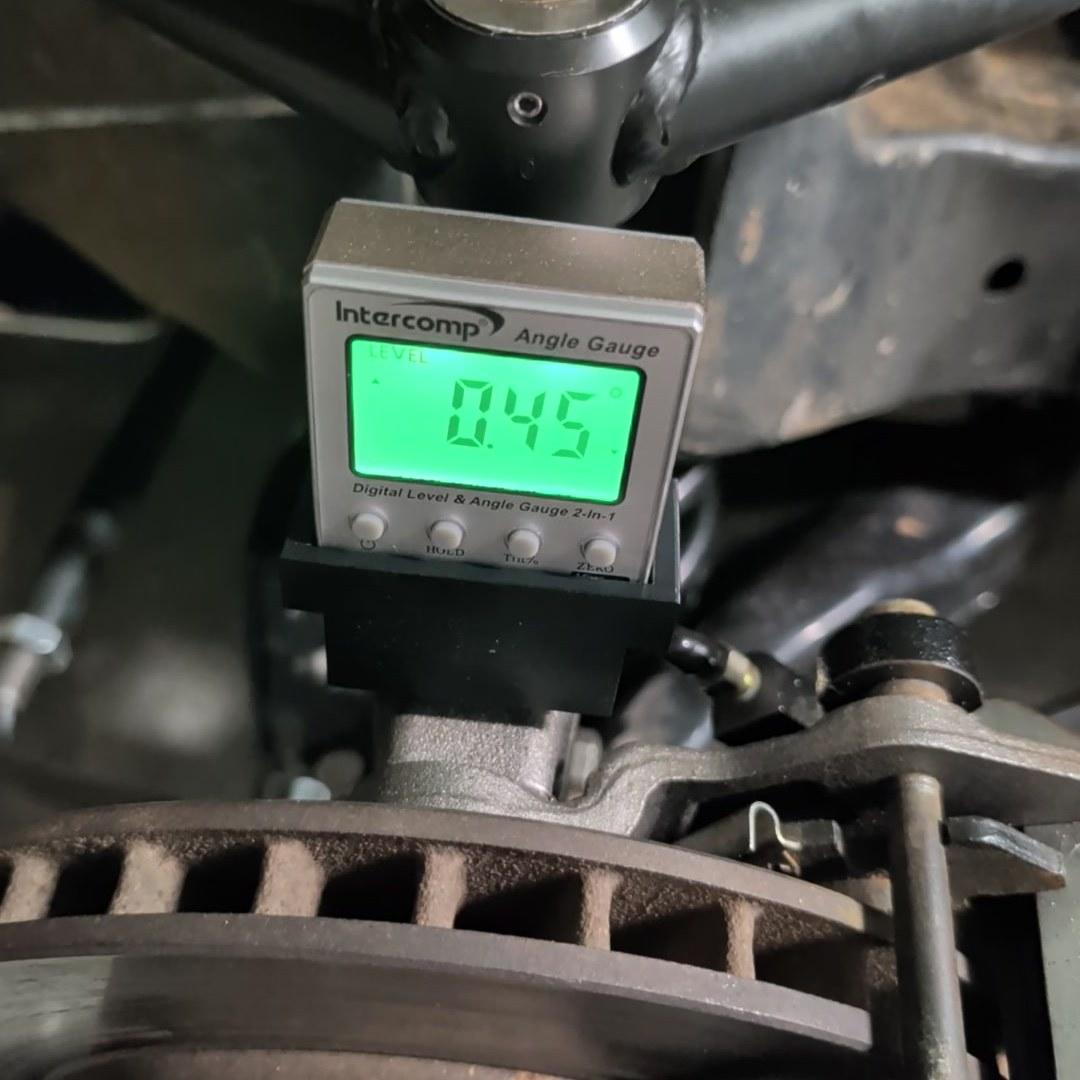
Read caster directly on the car. Fits over the knuckle on a Speedway 3-piece spindle, works with a digital level. No bubble sweep.
$39.99See the tool
Think something on this page is wrong? Use the button in the corner and tell me. That is how these get better.