
Free setup tool
TIRE STAGGER AND ROLLOUT CALCULATOR
Tape both rear tires and put the numbers in. It shows the circle a locked rear end wants to roll in, the stagger that fits your corner, and how much the tires have to slip when the two do not match.
REAR TIRES
THE CORNER
THE CIRCLE IT WANTS AGAINST THE CORNER YOU HAVE
The tire size difference is drawn five times life size and the circle at one sixth, so both fit in view.
When the blue circle lies on top of the dashed one, the tires roll around the corner without fighting. Blue wider than the corner means too little stagger. Blue tighter means too much.
- Rear stagger
- 2.50in
- RR goes 2.98% farther per turn of the axle.
- Circle it rolls on its own
- 182ft radius
- Stagger that fits this corner
- 2.53in
- Where neither rear tire has to slip to get around.
- Slip left over, per corner
- 2.1in
- The tires roll around without fighting.
THE CIRCLE THE AXLE WANTS, AGAINST STAGGER
More stagger, tighter circle. The curve is steep at the low end: the first inch of stagger changes the circle far more than the fourth. Where the curve crosses the dashed line is the stagger that fits your corner.
HOW FAR THE TIRES HAVE TO SLIP IN ONE CORNER
Through a half-circle corner the outside tire has to cover 201 inches more ground than the inside one. That number is pi times the track width and does not depend on how tight the corner is. Stagger covers some of it. Whatever is left, one tire or both have to slip.
THE NUMBERS
- LR diameter
- 26.74 in
- RR diameter
- 27.53 in
- Average rollout
- 85.25 in
- Axle turns per corner
- 79.6
Use the average rollout as the tire circumference in the gear calculator.
WHAT STAGGER IS
Rear stagger is the right rear circumference minus the left rear circumference. Rollout is the circumference itself: how far the tire rolls in one turn.
A locked rear end turns both tires the same number of times. If the right rear is bigger, it covers more ground each turn than the left rear does. The only way both can roll without slipping is for the car to turn left. Picture a paper cup rolling on a table. It goes in a circle because one end is bigger than the other.
THE CIRCLE IT WANTS
The size of that circle comes from similar triangles. The two tire paths are two circles, one track width apart, and their lengths are in the same ratio as the two circumferences.
radius to the middle of the axle = track width × (LR + RR) ÷ (2 × stagger)
Turn it around and you get the stagger that matches a corner of a given radius:
stagger = track width × average circumference ÷ turn radius
WHAT HAPPENS WHEN IT DOES NOT MATCH
In a corner the outside tire has to travel farther than the inside one. Through a half circle the difference is pi times the track width, no matter how tight the corner is. Stagger makes up some of that. If it makes up all of it, both tires roll freely. If it does not, the tires fight each other through the axle and something has to slip.
Too little stagger and the rear axle wants a wider circle than the corner, which pushes the car toward the wall. Too much and it wants a tighter one. On the straights the same stagger is always wrong, because a straight is a circle with no curve to it. That drag on the straight is the price of stagger.
WHAT IT LEAVES OUT
This is rolling geometry only. A dirt car is sliding, the rear tires are at a slip angle, and they are spinning under power, so nobody runs the exact number this gives. Tire growth, pressure and load change the rollout on the track. Use it as the baseline: it tells you which direction a stagger change moves the car and roughly how much.
More free tools on the setup tools page. It runs in your browser. No account, and nothing you enter leaves your machine.
From the shop
SPINDLE MOUNT CASTER TOOL
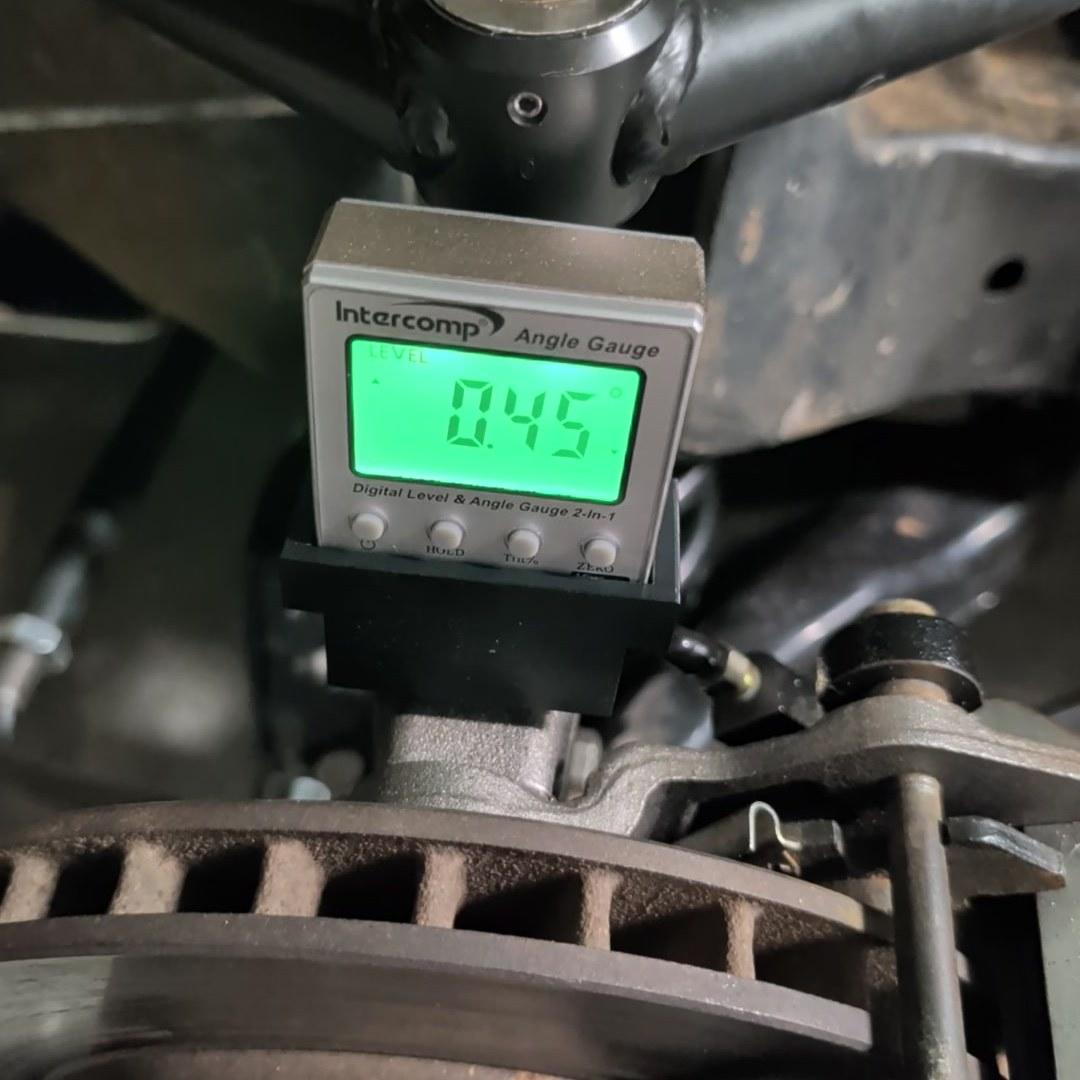
Read caster directly on the car. Fits over the knuckle on a Speedway 3-piece spindle, works with a digital level. No bubble sweep.
$39.99See the tool
Think something on this page is wrong? Use the button in the corner and tell me. That is how these get better.