
BUBBLE CASTER GAUGE VS. A DIGITAL LEVEL ON THE SPINDLE: THE NUMBERS
Same corner, same condition, read with a bubble caster gauge and with a digital level on a spindle fixture. Four paired checks, all within 0.2°.
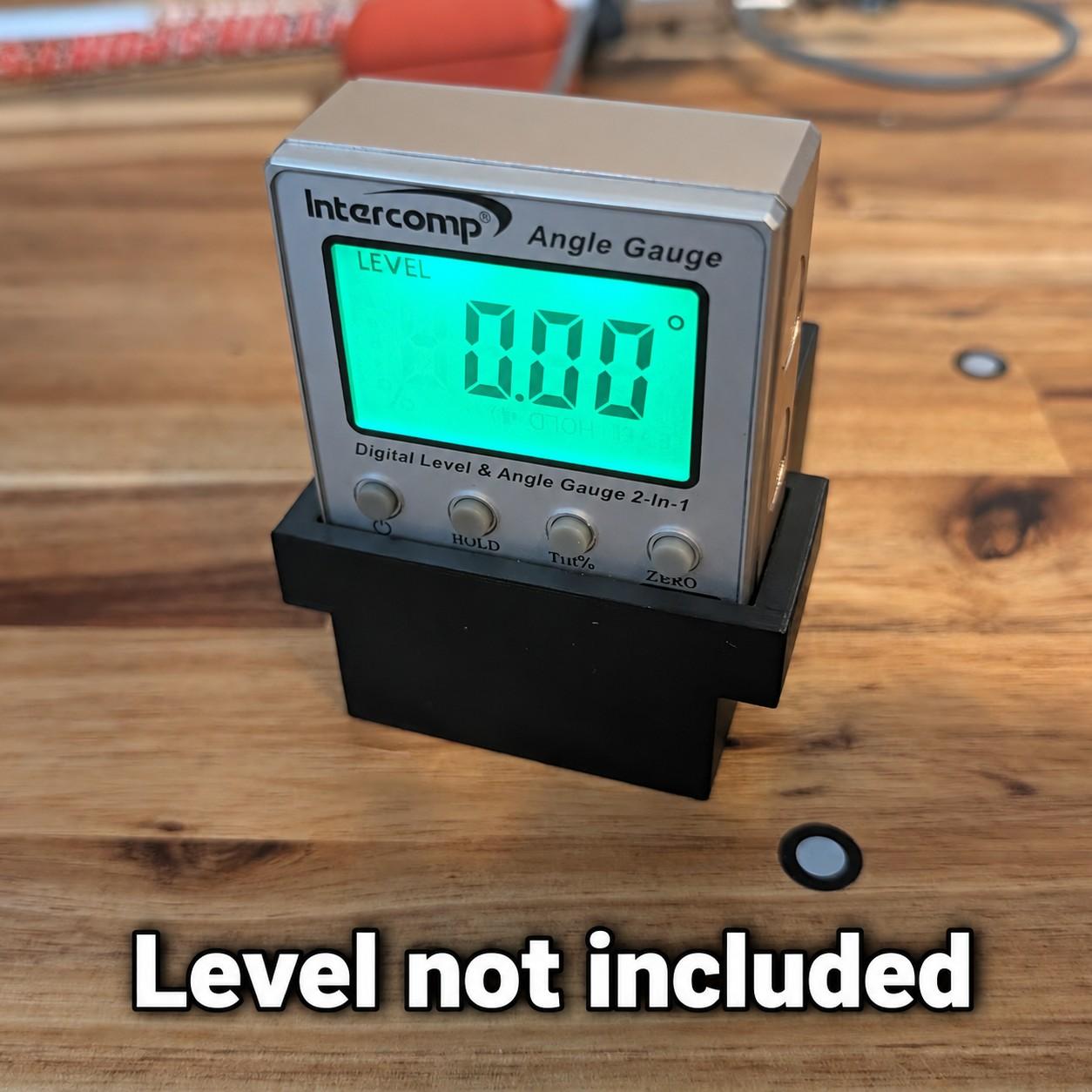
October 2026, my car, loaded. Each row is one corner read two ways under the same condition: a bubble caster gauge, and an Intercomp 102144 digital level on the spindle mount caster tool. A bubble gauge resolves about a quarter of a degree, so its reading is really a band.
| Corner | Condition | Bubble gauge | Level on fixture | Difference |
|---|---|---|---|---|
| Left front | Flat on setup plates | 0.35° | 0.45° | +0.10° |
| Left front | Fronts on turn plates, rears on the ground | 0.95° | 0.85° | -0.10° |
| Right front | Flat on setup plates | 3.0° | 2.95° | -0.05° |
| Right front | Fronts on turn plates, rears on the ground | 3.6° | 3.80° | +0.20° |
Four paired checks. The largest gap is 0.20°, inside what a bubble gauge can resolve.
THE SAME READINGS, DRAWN
Tap a corner and a condition. The green band is the quarter degree a bubble gauge can resolve. The blue dot is the digital level on the fixture.
The fixture reads 0.10° above the bubble gauge, inside the quarter degree a bubble can resolve.
Tap a row to see what that reading is.
Bubble gauge, with its quarter-degree band. Intercomp on the fixture.
Car loaded, level zeroed on the ground under the wheel before each reading, tire pointed straight along the frame rail. On setup plates the fixture and the bubble gauge land within 0.2° of each other on both corners. Flip to the turn-plate view and both gauges read about 0.6° high, because the fronts are up on plates and the rears are not.
WHAT THE TABLE SAYS
- The two methods agree within 0.2° on every pair. That is the limit of the bubble gauge, not the fixture.
- The turn-plate rows read about 0.6° higher than the flat rows on both corners, with both tools. That is the car sitting nose-up, not caster. Read it flat.
- Lift the fixture and reseat it and the reading comes back within about 0.1°. One printed tool reads within 0.2° of another.
WHY BOTHER WITH THE DIGITAL LEVEL
A bubble gauge needs a caster sweep: turn the wheel one way, zero, turn it the other, read. On setup plates you cannot swing a loaded wheel without jacking the car, twice. The fixture reads with the wheel straight, in one seat, and the digital level gives you hundredths instead of a bubble between two lines. The full procedure is in how to check caster with a digital level.
THE TOOL
MORE
- How to check caster on a circle track car with a digital levelRead caster straight off the spindle with a digital level and a fixture. Eight steps, what to zero, and how to know the reading is right.
- Check your digital level before you trust it: the flip testA digital level can carry a constant offset in one direction. Thirty seconds on a flat surface tells you whether yours does and how big it is.
- Reading caster: why the car has to be flat and the wheel straightTurn plates under the fronts with the rears on the ground add about 0.6° to every caster reading. A wheel turned off straight adds more. Here is why, with the numbers.
- What caster is on a circle track car, and how to read what you haveCaster in plain terms: what the angle is, what more of it does, why the two fronts are not the same, and how to measure yours without a caster sweep.
- Running a real circle track wheel on a sim baseWhich sim bases take a 3-bolt circle track wheel through a 70 mm adapter straight on, which need a universal hub, and how it bolts up.
- Putting an 18-inch truck steering wheel on a sim baseTwo adapters for the 18-inch Freightliner-style wheel: one for 70 mm quick releases, one for Logitech G27 and G29. Which one you need and what is in the box.