
CHECK YOUR DIGITAL LEVEL BEFORE YOU TRUST IT: THE FLIP TEST
A digital level can carry a constant offset in one direction. Thirty seconds on a flat surface tells you whether yours does and how big it is.
A digital level is only as good as its zero. Some read the same number whichever way you point them. Some do not, and the difference lands in every caster and camber reading you take with it.
THE TEST
- 1Set the level on a surface that is close to level. It does not have to be perfect.
- 2Read it.
- 3Turn it 180° in place, same spot, same surface.
- 4Read it again.
If the two readings match, the level has no offset. If they differ, half the difference is a constant offset built into every reading you take in one direction.
TRY IT
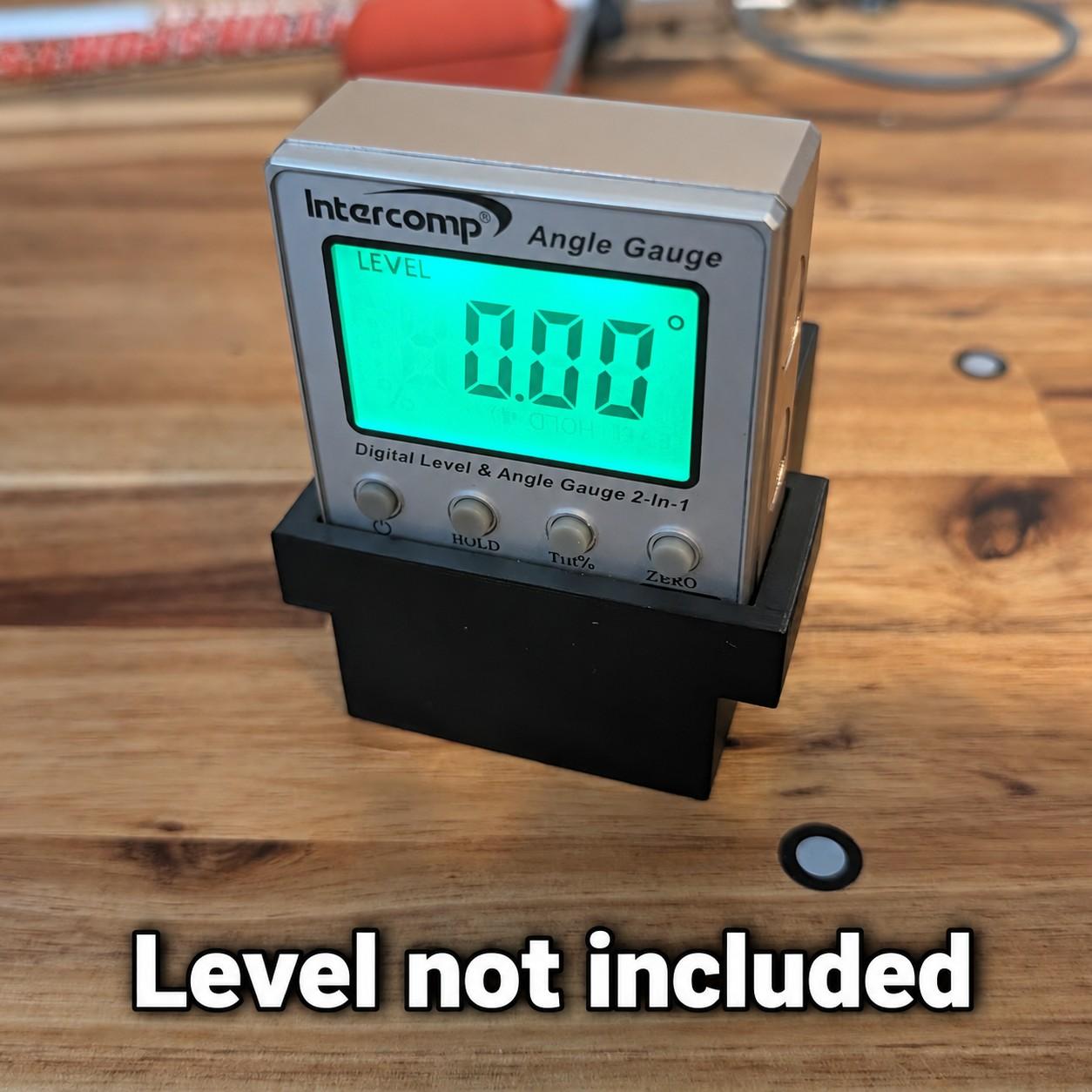
My DXL360 read 0.0 one way and 0.6 the other. Half of that gap, 0.3°, is in the level, and it lands in every single-direction reading. The Intercomp reads the same both ways, so one reading is enough. The bench does not have to be level for the test, only the same for both readings.
WHAT MINE DID
My DXL360 read 0.0° one way and 0.6° the other. That is a 0.3° offset in every single-direction reading. The Intercomp 102144 reads the same in both directions, which is why it is the level I recommend with the spindle mount caster tool, and why one reading is enough with it.
IF YOURS HAS AN OFFSET
- Subtract the offset from every reading, or
- Read both directions and average them.
Either way, zero the level on the ground directly below the wheel before every reading. The rest of the procedure is in how to check caster with a digital level.
THE TOOL
MORE
- How to check caster on a circle track car with a digital levelRead caster straight off the spindle with a digital level and a fixture. Eight steps, what to zero, and how to know the reading is right.
- Bubble caster gauge vs. a digital level on the spindle: the numbersSame corner, same condition, read with a bubble caster gauge and with a digital level on a spindle fixture. Four paired checks, all within 0.2°.
- Reading caster: why the car has to be flat and the wheel straightTurn plates under the fronts with the rears on the ground add about 0.6° to every caster reading. A wheel turned off straight adds more. Here is why, with the numbers.
- What caster is on a circle track car, and how to read what you haveCaster in plain terms: what the angle is, what more of it does, why the two fronts are not the same, and how to measure yours without a caster sweep.
- Running a real circle track wheel on a sim baseWhich sim bases take a 3-bolt circle track wheel through a 70 mm adapter straight on, which need a universal hub, and how it bolts up.
- Putting an 18-inch truck steering wheel on a sim baseTwo adapters for the 18-inch Freightliner-style wheel: one for 70 mm quick releases, one for Logitech G27 and G29. Which one you need and what is in the box.