
READING CASTER: WHY THE CAR HAS TO BE FLAT AND THE WHEEL STRAIGHT
Turn plates under the fronts with the rears on the ground add about 0.6° to every caster reading. A wheel turned off straight adds more. Here is why, with the numbers.
Caster is the angle of the steering axis against the ground. Anything that tilts the car or swings the axis changes what a level sees. Two things do it on a setup pad: the car sitting nose-up, and the wheel not pointing straight.
NOSE-UP: ABOUT 0.6°
Turn plates under the fronts with the rears sitting on the ground lift the nose by the thickness of the plates. The whole car pitches back, and the level reads that pitch as caster. On my car it was about 0.6° on both corners, with a bubble gauge and with a digital level on the fixture:
| Corner | Flat on plates | Fronts on turn plates | Change |
|---|---|---|---|
| Left front, bubble gauge | 0.35° | 0.95° | +0.60° |
| Left front, level on fixture | 0.45° | 0.85° | +0.40° |
| Right front, bubble gauge | 3.0° | 3.6° | +0.60° |
| Right front, level on fixture | 2.95° | 3.80° | +0.85° |
The whole car pitches back by the plate thickness over the wheelbase, and a level on the spindle reads that pitch as caster. On my car the turn-plate rows came out about 0.6° higher than flat, on both corners, with both gauges. Wheelbase and plate thickness here are typical figures to play with, not measured on my car.
Put plates under all four, or read flat on the floor. If you must read nose-up, add about 0.6° to the number. Better to not have to.
WHEEL OFF STRAIGHT: THE LEVEL STARTS READING SIDEWAYS LEAN
The steering axis leans back, which is caster, and it also leans sideways. With the wheel straight the level only sees the lean back. Turn the wheel and the level swings around the axis and starts reading part of the sideways lean as caster. A few degrees of steer is enough to move the reading, and it moves more on a car with more sideways lean in the axis.
So point the tire straight ahead, parallel to the frame rail, and check the tire, not the steering wheel. Play in the box and the column means the wheel can be centered while the tire is not. On setup plates you cannot swing a loaded wheel, so jack the car, turn it, set it down.
Drag the wheel off straight and watch the error grow:
The level swings around the steering axis, and with the wheel turned it starts reading part of the axis's sideways lean as caster. Four degrees off straight turns a true 0.45° into a reading over 1°. Get the wheel dead straight before you read it.
9° steering axis inclination is a typical figure, not measured on this spindle. Which direction adds and which subtracts depends on the side of the car.
The full procedure is in how to check caster with a digital level.
THE TOOL
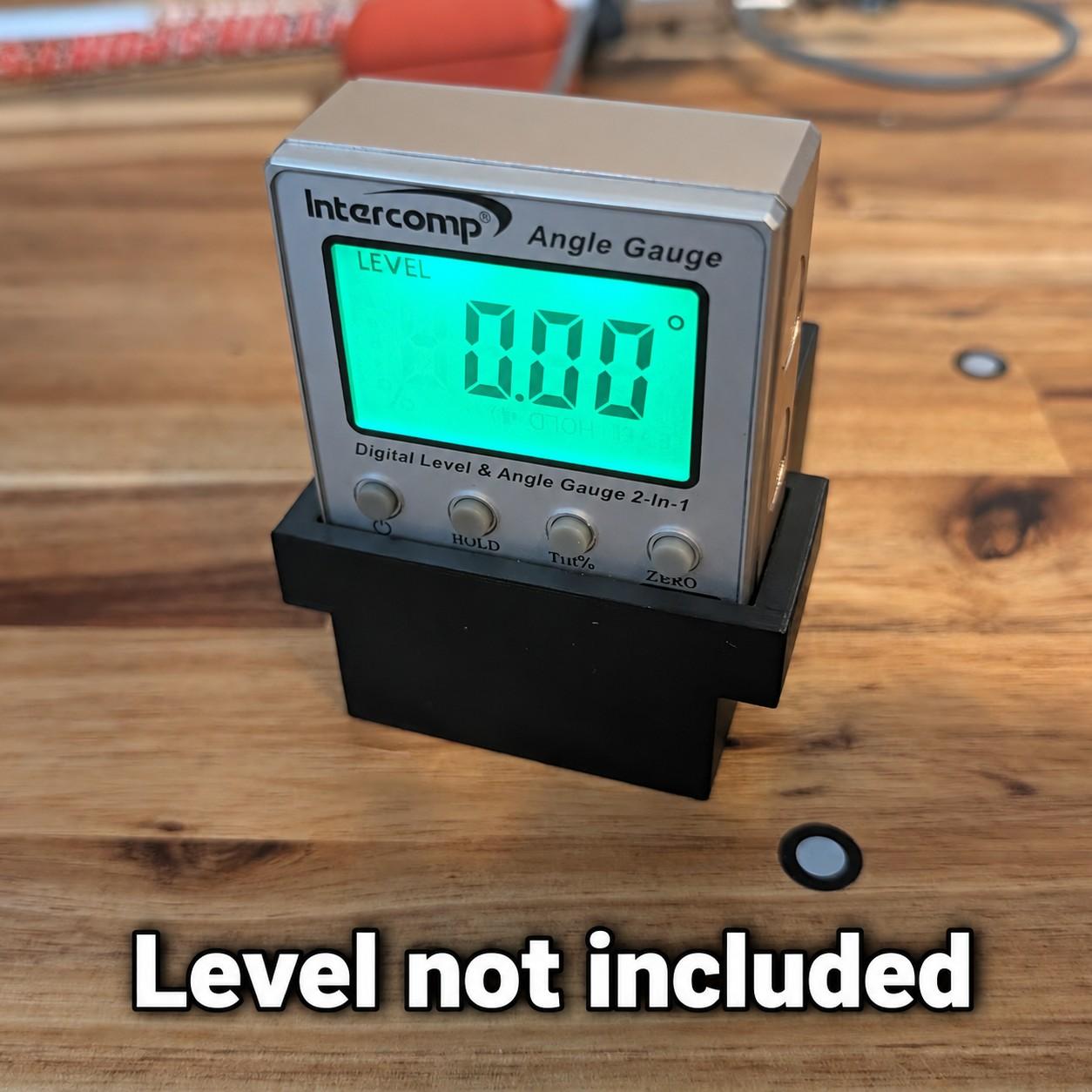
MORE
- How to check caster on a circle track car with a digital levelRead caster straight off the spindle with a digital level and a fixture. Eight steps, what to zero, and how to know the reading is right.
- Bubble caster gauge vs. a digital level on the spindle: the numbersSame corner, same condition, read with a bubble caster gauge and with a digital level on a spindle fixture. Four paired checks, all within 0.2°.
- Check your digital level before you trust it: the flip testA digital level can carry a constant offset in one direction. Thirty seconds on a flat surface tells you whether yours does and how big it is.
- What caster is on a circle track car, and how to read what you haveCaster in plain terms: what the angle is, what more of it does, why the two fronts are not the same, and how to measure yours without a caster sweep.
- Running a real circle track wheel on a sim baseWhich sim bases take a 3-bolt circle track wheel through a 70 mm adapter straight on, which need a universal hub, and how it bolts up.
- Putting an 18-inch truck steering wheel on a sim baseTwo adapters for the 18-inch Freightliner-style wheel: one for 70 mm quick releases, one for Logitech G27 and G29. Which one you need and what is in the box.